
Are shipping container homes legal? In most of the United States, yes, but through two different systems: seven states now force their cities to allow ADUs, and everywhere else the city decides. Australia is simpler still, with granny flat pathways in every state. The table below gives the one-line answer per jurisdiction, each backed by a verified profile.
Are shipping container homes legal? In most of the United States, yes, but the route to a legal container home splits into two very different systems. Seven states now write the rules themselves and force their cities to allow ADUs, with California the deepest of them; nearly everywhere else, the honest answer is that your city council decides. Australia runs a third model entirely, where every state has some form of granny flat pathway. This page gives the short answer per jurisdiction and hands you off to the verified state profiles behind each line, because container home legality is settled jurisdiction by jurisdiction: it is a zoning district, a size cap and an approval pathway on your specific lot.
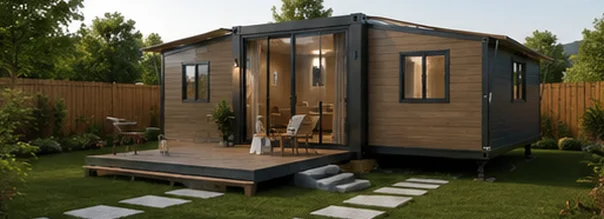
Are shipping container homes legal in California-style states?
The strongest yes in the country. California requires every city to allow an ADU on a residential lot, approves compliant applications ministerially, and deems an application approved if the 60-day clock is missed (Gov. Code §66317). A factory-built container unit that lands on your lot walks the same ADU pathway as any other: the state rules cover an 800 sq ft baseline with 4-foot setbacks, no impact fee at 750 sq ft or less, and no separate utility connection for most conversions. The full detail, including the fee lines, sits in the California rules profile.
Oregon and Washington work the same way. Oregon's mandate, implemented under DLCD's official guidance, obliges cities over 2,500 residents to allow at least one ADU per detached single-family dwelling inside the urban growth boundary. Washington (RCW 36.70A.681) goes further: two ADUs per lot in urban growth areas, with state floors the locals cannot undercut.
The states that joined recently
Three more states settled the question in the last three years. Colorado's HB24-1152 requires subject jurisdictions, municipalities of 1,000-plus residents in metropolitan planning areas and qualifying county areas, to allow one ADU by administrative approval, effective 30 June 2025. The same law voids HOA prohibitions, bars three specific local practices, and attaches a $5 million fee-reduction grant program worth up to $15,000 per ADU in supportive jurisdictions. Arizona's HB 2720, signed in May 2024, makes cities above 75,000 residents permit one attached and one detached ADU per lot, with ordinances due in place by 1 January 2025. North Carolina has the newest law of all: the Regulatory Reform Act of 2026 creates G.S. §160D-917, requiring cities of 50,000-plus outside coastal areas to allow ADUs within an 800 to 1,000 sq ft size band, applying to permit applications from 15 January 2027. Utah splits the answer in two, which matters for container buyers: internal ADUs are permitted by right statewide in any primarily residential zone, while detached units became a required permitted use on qualifying lots in larger cities only from 1 October 2026. Each of these is verified line by line in its rules profile.
Container home zoning where the state stays out
Texas, Georgia and Florida have no statewide ADU mandate, so container home zoning is a city document. Houston publishes its own ADU pathway with no zoning step but full building-code review; Austin allows additional dwelling units on lots of 5,750 sq ft or more and restricts short-term rentals; Dallas runs an overlay system. In Atlanta, detached ADUs are legal only in R-4, R-4A and R-5 districts at 750 sq ft, and Florida takes yet another shape: state law authorizes local ordinances but mandates none, and where an ordinance exists the permit application carries an affordable-rent affidavit. The practical lesson for these states is to read your city code before buying a unit, because the same container home can be legal on one side of a street and unpermitted on the other.
The rules that follow you everywhere
Whatever the state, three rules travel with any container home. A building permit is always required: factory-built or site-built, the unit must meet the local code and pass inspection, which is why component certifications from the factory do not replace the on-site sign-off by licensed trades and the local certifier. Second, the unit rarely gets its own title: California, the ACT and the NT all forbid subdividing an ADU into a separately sold lot, so the container home is real estate attached to yours. Third, use rules bite after approval: short-term rental limits like Austin's, owner-occupancy conditions in a few JADU cases, and historic-district review can all shape what you may do with a legal unit.
Denial grounds are narrower than they used to be, and California is the sharpest example. There, a city cannot reject a compliant ADU over nonconforming zoning conditions or unpermitted existing structures that pose no health and safety risk (§66322), parking cannot be required within a half-mile of transit, and the state floors, 800 sq ft with 4-foot setbacks for a detached unit, cannot be negotiated downward by local design review. Washington runs the same logic with parking caps tiered by transit access and unit size, plus state minimums its cities cannot undercut. The direction of travel across every mandate state is identical: the standards that once killed container home projects at the hearing stage are being replaced by numeric standards you can check before you spend anything.
The state-by-state table
| State | Standing | One-line answer |
|---|---|---|
| California | Statewide mandate, deepest | Legal statewide by ministerial approval; deemed approved if the city misses 60 days |
| Oregon | Statewide mandate | Legal for cities over 2,500 inside the urban growth boundary |
| Washington | Statewide mandate, two ADUs | Legal in urban growth areas, state minimum floors apply |
| Colorado | Statewide framework | Subject jurisdictions must allow one ADU administratively; HOA bans void |
| Arizona | Mandate on big cities | Cities over 75,000 must allow one attached and one detached ADU |
| Utah | Split mandate | Internal ADUs by right statewide; detached required in larger cities from Oct 2026 |
| North Carolina | Newest mandate | Cities 50,000+ non-coastal, size band 800 to 1,000 sq ft |
| Texas | City by city | Houston, Austin, Dallas and San Antonio each write their own pathway |
| Georgia | City by city | Atlanta allows detached ADUs in three districts, 750 sq ft cap |
| Florida | Local option | State authorizes ordinances; adopting cities require an affordable-rent affidavit |
Every line in that table expands into a verified profile with statutes, clocks and fee rules; the US hub lists all ten and the Australia hub covers the eight Australian jurisdictions.
Are shipping container homes legal in Australia?
Yes, and Australia's version of the question is easier to answer, because every state runs a granny flat pathway with published numbers. The caps run from 60 m² in NSW, Victoria's small-second-home pathway and Tasmania to 90 m² in the ACT, with Western Australia and South Australia at 70 m². Several states exempt small units from planning permits entirely: Victoria since December 2023, Western Australia since April 2024 for units up to 70 m², and NSW's complying development track carries a 10-day determination clock. Renting one out to anyone is legal nearly everywhere after the 2022-2024 reform wave, and the approval clocks are statutory, which is why the timeline page can tabulate them state by state. The state profiles carry each pathway, and the granny flat prices page carries what the governments publish around building one.
The short version
Are shipping container homes legal where you want to build? If your lot sits in one of the seven mandate states, state law does the arguing for you and the profiles above give the exact standards. In city-by-city states, the city code is the document that decides, and reading it before ordering a unit is the cheapest step in the whole project. Either way, container home legality is settled one lot at a time, and every lot has a profile behind it in this database.
FAQ
Yes at the state level, no at the lot level, and the split is between two systems. Seven states, California, Oregon, Washington, Colorado, Arizona, Utah and now North Carolina, write standards their cities must allow. Texas, Georgia and Florida leave the decision to each city, so the same container home can be legal in Houston and unpermitted across a county line. The state-by-state table above gives the one-line answer, and each state profile carries the statute behind it.
Yes, everywhere in this database. Legality settles the zoning question; the permit settles the construction question. A factory-built unit arrives with component certifications, and the installation is inspected and signed off on site by licensed trades and the local certifier against the local code. No state in this database waives the building permit for any dwelling, container or otherwise.
Yes, and the caps are numeric. California protects an 800 sq ft baseline with 4-foot setbacks, North Carolina locks its cities into an 800 to 1,000 sq ft band, Atlanta caps detached ADUs at 750 sq ft, and Australia runs 60 to 90 square metres depending on the state. The verified number for your jurisdiction is in the relevant state profile.
In the mandate states, increasingly no. California bars denials over nonconforming conditions that do not threaten health and safety and sets design floors the city cannot negotiate down. Washington pairs its two-ADU mandate with state minimums. In city-by-city states, design review is still real, which is another way of saying: read the local code first.
In most of this database, yes. California removed owner-occupancy requirements for ADUs from January 2024, Queensland and South Australia legalized renting to anyone in 2022-2023, and Western Australia followed in 2024. The exceptions to check: Florida ordinances require an affordable-rent affidavit, Austin restricts short-term rentals, and JADUs in California can carry owner-occupancy conditions where sanitation is shared.
- Gov. Code §66310-66342 (California ADU statute); leginfo.legislature.ca.gov (accessed 2026-09-21)
- ORS 197.312 (Oregon ADU mandate, via DLCD guidance); RCW 36.70A.681 (Washington); C.R.S. 29-35-401 et seq. (Colorado); Utah Code §10-21-303/.304; Ariz. HB 2720 (Laws 2024, Ch. 196); N.C. S.L. 2026-59; official legislature pages (accessed 2026-09-21)
- Fla. Stat. §163.31771; City of Atlanta zoning; City of Austin ADU page; official pages (accessed 2026-09-21)
- Ten US and eight Australian rules profiles on this site, each independently verified Sep 2026
Something look off: a fee, a date, a rule? Email tianxin@sunmodu.com. Every message gets reviewed and accepted fixes are dated right here on the page, and with your okay, we'll thank you by name for pointing it out.